



Lulan
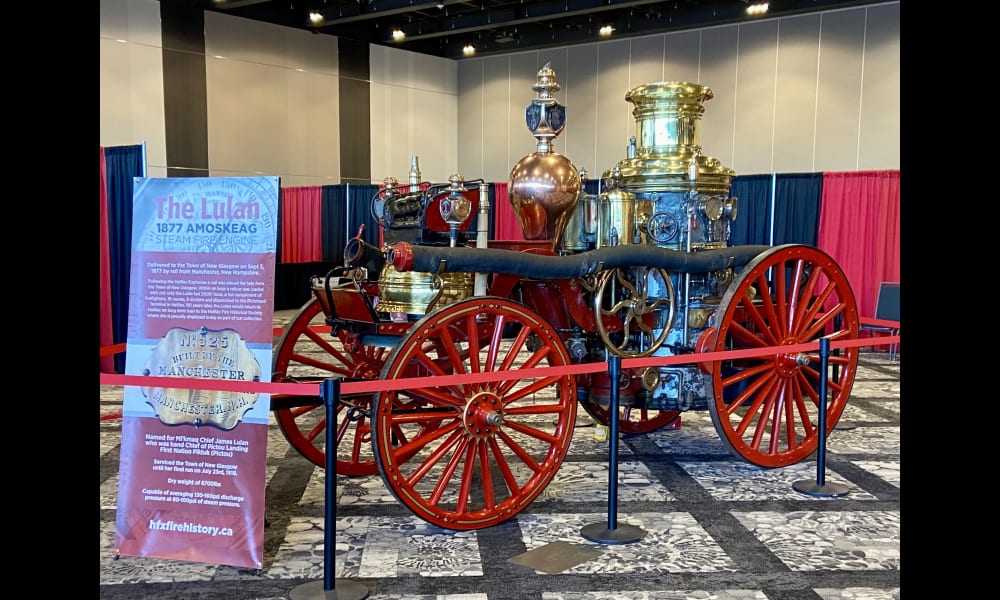
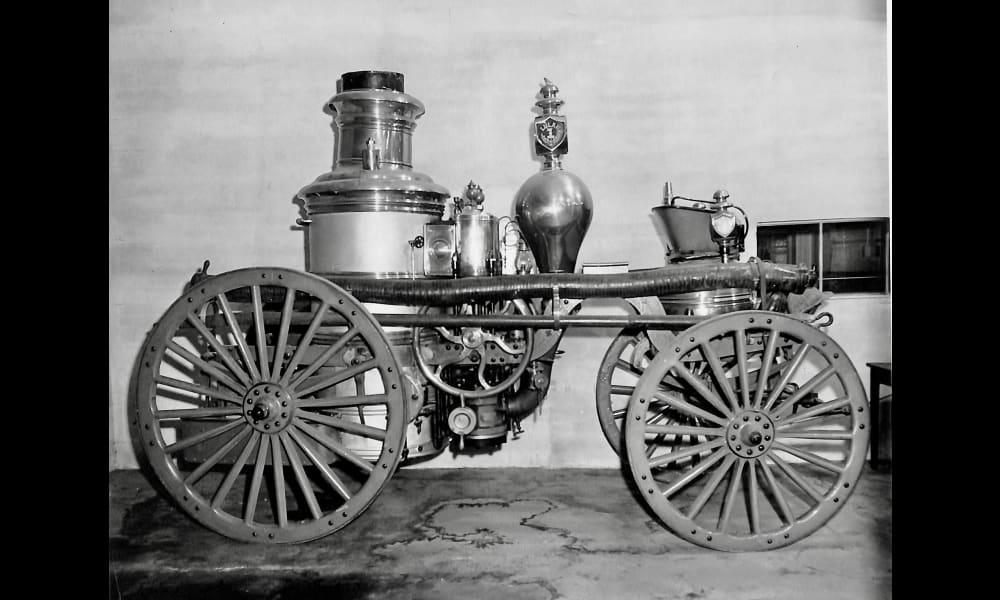
- Purchased at a cost of roughly $4700 for the Town of New Glasgow in 1877 after two large fires in 1874 and 1875 destroyed much of the downtown of the community.
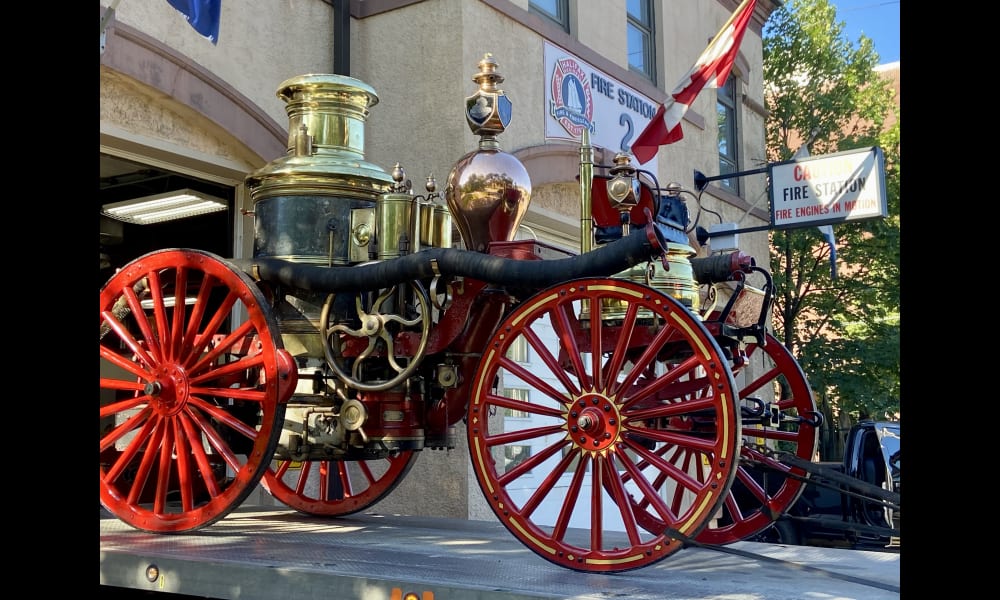
- No 525, built by Manchester Locomotive Works, (previous to 1859 known as Amoskeg Locomotive Works) of Manchester New Hampshire in 1877
- Second Class Double Plunger, Harp model.
- Named “Lulan” after a local Mi’kmaq Chief from the area that died in 1827 at an age of approximately 97.
- On the morning of the Halifax Explosion, December 6th, 1917, word was sent of the disaster to the Town of New Glasgow who immediately had the Lulan along with hose, other firefighting equipment and 19 volunteer members of their force loaded onto a flatdeck railcar and dispatched to Halifax. She was never put into service in Halifax as the threads on her fittings could not be adapted to Halifax’s equipment.
On January 2rd., 1877, the Committee on Pumps and Wells (Jeffrey McColl, Jas.Copeland) reported to Mayor Adam C. Bell that it had become absolutely necessary to find more sufficient means of putting out fires and recommended $6000 for a new fire engine and a further $2000 to build a suitable house for the Steam Fire Engine.
On the fifth of May, 1877, the fire committee made up John Cumming, James W,.Copeland, and Fraser Submitted a report to the council requesting the purchase of a Steam Fire Engine. Councilor Angus McQueen moved that Mayor Jeffrey McC I be authorized to purchase one immediately. Councilor Copeland seconds the motion this meeting many proposals and letters of information on fire apparatus had been tabled.
It had been decided on August 22, 1877, that the new steam fire engine would besituated at the Market House.
A set of rules of the New Glasgow Steam Engine Co. was established on 23rd August, 1877. The material for this information comes from the pamphlet published by G. W. Chisholm, New Glasgow N.S.. The pamphlet reads as follows
ORDER OF BUSINESS
- Roll Call.
- Minutes.
- Dues and fines collected.
- Elections of Members and Officers.
- Application for Membership.
- Reports of Committee.
- Deferred business in order of Receipt.
- New business and statement of receipt.
- Roll Call.
- Adjournment
RULES
RULE 1. Sec. 1. This Company shall be known as the New Glasgow Fire Engine Company, and shall consist of no less than twenty five members.
Sec. 2. The Officer of the Company shall be - Captain, 1st. Lieutenant, 2nd Lieutenant and and Secretary Treasurer, all of whom shall be elected by ballot at the Annual Meeting, and they shall assume their duties immediately after their election.
Sec. 3. In the event of a vacancy occurring among the Officers, or Company, it shall be filled as soon as the Company are made aware of the fact.
Sec. 4. The Company shall be divided into two Sections, - 1st Leading Hose men; 2rd Suction Hose men, and Engine men. The leading Hose men shall be subdivided into two Sections, one of having charge of each branch, when two streams are playing. When only one stream is on, all the Leading Hose men look after the hose. The leading Hose men shall be appointed by the Captain, to the charge of the reels, an equal number of each.
Sec. 5. The Suction Hose men shall first see to the suction hose, after which they will assist the Engine men.
Sec. 6. The Engine men shall be an Engineer and fireman, who shall be appointed and paid by the Town Council, and on their appointment shall become members of the Company.
Sec. 7. Sec. 1 and 2 shall be appointed by the Captain immediately after his election.
RULE II. Sec. 1. It shall be the Captains duty to preside on all Regular and Special Meetings of the Company, enforce order and give the casting vote only; he shall have command at all fires, trials and demonstrations, and he shall have power to call a Special Meeting of the Officers or Company when he deems it necessary.
Sec. 2. It shall be the duty of the 1st Lieutenant to take command of Section 1 at fires, under the Captains direction, and in the Captains absence to take his place and perform his duties.
Sec. 3. It shall be the duty of the 2nd Lieutenant to take command of Section 2 and 3 at fires &c.. Under the Captains directions, and in the absence of the Captain and 1st Lieutenant, take the Captains place and perform his duties.
Sec. 4. It shall be the duty of the Secretary Treasure to keep a correct list of the Company, a copy of these rules, and minutes of all meetings, he shall call the roll at the hour stated for meeting, and at the close of all meetings, and fires, he shall notify all members of Special meetings, and newly elected members of the election, within one week thereafter. He shall notify the Fire wards and Fire Committee of the Town Council of a change of Officers within twenty four hours: he shall collect all fines and assessments, keep a correct account of all monies, and pay all bills ordered by the Company; he shall carry on all correspondence and write all notices ordered by the Captain or Company; he shall keep a correct account of all fires and exercises and report them at the annual Meeting.
Sec. 5. As soon as the money is in the Secretary's hands exceed Five Dollars, he shall place it in the Saving's Bank to the Company's credit, and at the expiration of his term of office he shall hand over to his successor all the property of the Company in his possession.
Sec. 6. For each neglect of duty the Company shall impose a fine not to exceed One Dollar, and if he fails to have his books present at the time of the opening of a meeting whether present himself or not he shall pay a fine of twenty five cents.
Rule III Sec. 1. Any member who shall absent himself from duty or shall be guilty os improper or disorderly conduct, at any meeting or fire, or who shall disobey the order of the Officer in charge shall be fined or expelled as the Company may determine.
Sec,. 2. On the alarm of fire each member shall proceed to the scene of action and assume his duties, and shall not leave unless by permission of the Officer in charge until after roll call, under a penalty of 25 cents.
Sec. 3. Any member who shall absent himself from three regular meetings without reasonable excuse, or shall allow his fines to exceed $1.50, shall be expelled and sickness of leave in writing from the Officer in charge shall be the only excuse admissible for non-attendence.
4. Any member, by to the Captain can obtain leave of absence for a period to exceed six months, provided he gets a substitute approved by the Company, or he may send a substitute to any meeting of the of the Company, but he is liable to all fines his substitute may incur under rule VII.
RULE IV. Sec. 1. The regular meeting of the Company shall be held on the 2nd Monday of every month, the Annual Meeting being on the 2nd Monday of January, and the hour of all meetings, unless otherwise ordered, shall be 7 P.M.
Sec. 2. Five members, stating cause, may demand a meeting, and in case of Special Meetings shall receive written notice not less then twenty four hours before such Special Meeting. Such members notice may be left at his residence or place of business.
Rule V. Sec. 1. Every candidate for admission to the Company shall be proposed in writing by two members, such proposal shall lie on the table one month, and than by majority vote of the Company only, the candidates name shall be placed on the books.
Sec. 2. When a vacancy occurs in the Company the new member shall be elected by ballot from the whole list of candidates on the books, and a majority vote is necessary for election.
RULE. VI. No members shall appear at drill meetings or ordered unless clothed in the uniform of the Company, which uniform shall be dark blue serge shirt trimmed with white braid, black cloth trousers, and regulation hats and belts.
RULE VII. Sec. 1. Any member guilty of neglect of duty, if fined, shall be liable
to any fine the Company day determine under one dollar.
Sec. 2. Any members appearing at drill meetings or when ordered, without
uniform, 10 cents.
Sec. 3. The fines for regular meetings shall be,- after roll call, 5 cents; non attendance 10 cents; no key for engine house, 5 cents; leaving meeting without leave, 20 cents; on drill meeting, after engine has left the house, 25 cents, non attendance, 50 cents, absence from fires or alarms, 25 cents.
Sec. 4. The fines for special meetings shall be the same as for regular meetings except as specified, and all fines shall be collected at the next regular meeting after they are incurred.
RULE VIII. Sec. 1. The Captain at regular meeting immediately after his election appoint a committee of Audit to examine the books of the Secretary Treasurer, and they shall report at the next Regular Meeting under a penalty of 50 cents.
Sec. 2. All meetings of the Company shall be governed by the usual Rules of Order.
Sec. 3. A two third vote is necessary, 1st, to expel a member, 2nd, to make any appropriation of money except to pay debts; 3rd to approve; 4th to repeal, alter, amend, or suspend, any rule or section of rules; 5th, to suspend or depose any office of the Company and appoint his successor
As recorded in the Eastern Chronicle on Sept. 6th, 1877:
"A handsome Steam Fire Engine had arrived here by rail from Manchester, New Hampshire on the 5th. The machine was the center of attraction to the men and boys of the town for an hour or two previous to its being transferred from the platform cat to the room provided for under the Town hall. An Engineer is hourly expected from Manchester to conduct a public trial on the engine before its acceptance by the Town Council,. The Manchester Works from which the new engine was purchased has the best reputation of any similar establishment in New England, if not in the United States, for the manufacture of steam fire engines.
The LULAN, as the New Glasgow steamer has been named, is probably the best firefighting implement in the Province. The Fire Insurance Company please make a note of our enterprise in this matter, and trimmed their rates accordingly."
Trial of the Lulan As recorded in the Eastern Chronicle, September 13th., 1877:
"The Lulan" was given a public trial Thursday afternoon in the presence of the Warden, Councilors, a large concourse of citizens and most of the juvenile population. Steam was first got up on the Market Square and blown off after the machinery had been running a few minutes. The fuel was then all taken out, fresh water pumped, coal taken on board and fuel placed in the furnace ready for lighting, after which the engine was taken to the public wharf drawn by a span of Mr. Church' horses. Mr Wilson, the Manchester Company's representative assisted by Mr. John Fraser (of Wm. Fraser & Sons Foundry), who is to have charge of the engine, operated during trial. Steam was got up to 20 lbs. in 4 12 minutes, 50 lbs. in 6 112 minutes, and rapidly went up to one hundred pounds after the engine was started. A stream was thrown from thirty to forty feet higher than the bank of Nova Scotia (one of the highest building in New Glasgow), through one hundred feet of hose and an inch and an eighth nozzle. A thousand feet of hose was used next, which led up the steep hill to St Andrews Church, when a steam was thrown as high as the ball surmounting the vane of the church. Five hundred feet of hose was added, which brought the line to point a little beyond the junction of Fraser's Mountain and little Harbor Roads, a height probably 150 feet above the level of the river, and a steam was thrown thence a little less in volume and height from that driven through the shorter lengths. The next trial was through 500 feet of hose, one nozzle being stationed on Water Street, the other on Provost, when streams were sent high above the summit of the surrounding roofs.
The trials, we understand was quite satisfactory to our municipal rulers, and the "LULAN" is now the property of the town. The engine was delivered here with all-expense paid by the makers, for $4500. Add to that sum $1300 for 1000 feet of gutta percha hose, $150 for three hose reels, and incidental expenses, and amount of the latest outlays of the town for fire purpose will reach about $ 6000."
VERY SAD ACCIDENT
As recorded in Eastern Chronicle, September 13, 1877. While the streets were swarming with children of the town on Thursday, the schools having been dismissed a little earlier than usual on account of the public trial of the new fire engine, doubtless many feared that one or more would be hurt before the proceedings came into termination. The fears of most apprehensive, however, could not have led to a premonition of a more lamentably sad accident than that which occurred after a large number of had witness the entire proceedings had gone home to tea and while they were calmly discussing the events of the afternoon. While the engine on its way to its room, was turning the corner of Archimedes and Market Streets, Maggie MacDonald, aged about seven years, daughter of Mr. Alex MacDonald (who Recently the fingers of one hand in the McKenzie Mills), was knocked down by the horses and the engine wheel passed over her head and body, almost instantly killing her. An ineffectual attempt was made by a little boy to rescue her from her perilous position just as the horses can in contact with her. The horses were driven at a moderate pace, and no blame is attached to the driver, as he did not see the danger until it was impossible to avert so far as he was concerned. Something strange is the fact that the deceased had been detained home by her parents during the trial, through of fear that harm befalling her, and she was out on an errand when overtaken by the accident. An inquest was held by Geo. Murray M.D., coroner, and a verdict returned in accordance with the above facts. Mr. And Mrs. Macdonald has the sympathy of the entire community in the untimely bereavement."
Having now established its ability, housing location, and rules for members operating it, the only thing left was for its legal transfer of ownership. A memo of cash for the Steam Fire Engine and Appliances were handed into Council by the clerk - D.C. Fraser on September 15., 1877, but the "Lulan" was not to be received until paid for and amounts could be correctly given.
Councilor Cumming reported that John Fraser (Foundry) had been engaged as Engineer of the Team Fire Engine "Lulan" at a salary of one hundred dollars per annum to start from the time of his taking charge, Council passed the appointment on December 20, 1877.
From viewing the Auditor's report of 1877 it was noted that payment of $3827.58 had been paid to Manchester Engine Works of New Hampshire, the makers of the Lullan.
From this point on the Lulan would become the legal property of the Town of New Glasgow.
The first members of the Steam Fire Engine Company, as recorded on April 8th 1878, are as follows: James A. McGregor, R. McGregor, Alexander Fraser, David Cameron, William T. Fraser, Andrew McDonald, James Murray, Duncan Fraser, John Ross, David A. Hogg, Henry Cunningham, Ronald MacDonald, Thomas Fraser, William McKay, and Robert Ballantyne.
Members at first had little experience in handling the steam fire engine. It would only be natural to have some difficulties in handling the new engine during a fire situation. All the pressure and excitement of handling the new engine knowing that many spectators are watching your every move, can make any man nervous One must remember the only engine previous to this was the "New Glasgow". The New Glasgow was a hand fire engine. The Hunneman C. records an order from the Town of New Glasgow as follows:
No. 545 - New Glasgow N.S. April 28, 1855.
The 5 1/2" refers to the cylinder (or pump) size. Mr. P.H. Cleaveland of the Yarmouth Firemen's Museum, (Letter of Oct. 9, 1987), informs me that there were many models so that until a picture of the New Glasgow shows up, we may never learn what she actually looked like.
One incident of mismanagement brought to the notice of the Council on July 29., 1878, indicate that the fact of the Steam Fire Engine being out of coal at the Chisholm's and is being secured by the Fire wards and what was unused was left on the grounds and wasted.
The Fire Committee reported that they engaged three Engineers to run the Steam Fire Engine: Robert Graham, Robert Fraser, George Decoste. Robert Fraser was to be paid $50.00, while Robert Graham and George Decoste were to ger $25.00 each per annum, for also for every time Steam was raised in the engine they be allowed ($2.00), for cleaning. This agreement was signed on December 5th, 1878, by John Cumming and Peter A. McGregor.
In 1879 the members of the Steam Fire Engine Company were reported as follows: James A. McGregor, Andrew McDonald, Robert A. Walker, Alexander Fraser, William Betts, David Cameron, Duncan Fraser, William McKay, James D. Fraser, George Decoste, James [ ], W. Matheson, David A. Hogg, R. McGregor, James Eastwood, William T. Fraser, Ronald McDonald, John Ross, Stanly McCurdy, Robert Graham, Alexander Chisholm, and John Barly.
In 1880 the members of the Steam Fire Engine Company were reported as follows: James A. McGregor, Andrew McDonald, Robert A. Walker, Alexander Fraser, William Betts, David Cameron, Duncan Fraser, William McKay, James D. Fraser, George Decoste, James [ ], W. Matheson, David A. Hogg, R. McGregor, James Eastwood, William T. Fraser, Ronald McDonald, John Ross, Stanly McCurdy, Robert Graham, Alexander Chisholm, and John Barly.
A wharf on the north side of the bridge on the west side of the River was recommended to place the Fire Engine in case of fire on that side of the river. The only surviving evidence of this said wharf is the sloping ramp or path leading from the end of the Carmichael Park. This path leads downwards toward the bottom level of the park facing into the present day bridge. On July 23, 1880 a contract for such a wharf for that purpose was drawn up and not to exceed fifty dollars. On July 30th. John Hill was paid twenty six dollars and fifty two cents for said wharf. Other account on the wharf report that on the 7th of September the following were paid: Hugh Ross - Trustee of wharf, $11.64; Newman Betts and others for work, $16.50; and D.S. Fraser - posts at wharf, $1.30.
FOORD PIT DISASTER - 1880
On Sunday November the 4th., 1880, the Fire Committee and Fire wards of New Glasgow places the Lulan at the Albion Mines in Stellarton, The New Glasgow Town Council approved of their action and further wrote to the Halifax Company stating that they could keep the Lulan as long as it is needed. The explosion at the Mine took forty four lives. Hearing the actions of the Lulan, the Manchester Locomotive Works sent a letter including a set of valve springs and packing free of any charge. The Town Clerk, A.M. Fraser, was ordered on the 29th. to pay the firemen $2.00 per day for Engineers. The firemen at night were to receive $1.50 and during the night $1.00. This being the account of the true bill for the Disaster for men employed. A. Marshall charged $3.50 reduced from $5.00, for taking the Lulan with horses up and down the Foord Pit. Resident Manager James Hudson at that time wrote Town Council and credited the Brigade for saving the main "drawings" of the Foord Pit. The Pit unfortunately, was never again re-opened.
In 1882 the members of the Steam Fire Engine Company were reported as follows; In 1880 the members of the Steam Fire Engine Company were reported as follows: James A. McGregor, William Fraser, Jim McDougall, S.T. McCurdy, Robert A.Walker, George Gibson, Alex Fraser "Saddler", Wm. Betts, Ronald McDonald, Robert Fraser, Alex Chisholm, Peter R... Meikle, Duncan C. Cummings, David McKenzie, Daniel Chisholm Tanner, John Walsh, Chas. McFadgen.
In 1883 the members of the Steam Fire Engine Company were reported as follows; In 1880 the members of the Steam Fire Engine Company were reported as follows: James A. McGregor (Captain), R.A. Walker, Jim McDougall, S.T. McCurdy, Daniel Chisholm, George Gibson, Robert Fraser, Chas. McFadgen, J.R. Cunningham, Duncan McDougall, Sam Copeland, David Fraser, John G. Thompson, Phillip Smith, David McKenzie, John McKinnon, Edward Walsh, and John A. McKenzie. Robert Fraser, the first Engineer of the Lulan, had resigned and Robert Graham was named substitute on June 21, 1884.
In 1888 the members of the Steam Fire Engine Company were reported as follows; Alex Fraser "Saddler", William T. Fraser, R.S. McDonald, S.T. McCurdy, Robert Fraser, Robert Meg. Fraser, Peter R. Meikle, Jim W. McDougall, D.A. Fraser, John McKay, Fraser Tupper, David McKenzie, A. Cook, Jas. Smith, Arch. McKenzie, A.T.Rice, David M. Fraser, A. McKay, William Chisholm Jr., Alex Fraser, and William Roache.
The Board of Works, in Halifax, sent Mr. Spilmaywho appraised the Amoskeag at $2000.00 for possible purchase. The Town of New Glasgow recorded several times as trying to sell either the Lulan or the Ronald. The Ronald was another Steam Fire Engine bought by the Town in 1885, and sold to St Raymond, Lower Canada on August 10, 1899.
The Lulan not being sold was called to be ready for at any time it called upon. Hisorder was placed by the Town Council Don April 3, 1889.
On September 10, 1889, Letters and replies between mayor Sutherland and the Town of Antigonish in relation to the purchase of the Steam Fire Engine "Lulan". The Fire Committee was then authorized to send the Amosteam Fire Engine to the Town of Antigonish on trial as long as the Town of Antigonish promises to send return the Engine when notified by the New Glasgow Town Council if required by he Town of New Glasgow.
TESTING OF LULAN IN ANTIGONISH
This bit of information was recorded in an article from an early newspaper of which the name is unknown. "The Amoskeag Fire Engine arrived from New Glasgow on Thursday afternoon. She was in charge of Chief Walker and Engineer Ormiston of New Glasgow fire department. Mayor Sutherland and Councillor McIntosh, of New Glasgow were also down to give any information desired.
The engine is of the make known as the Amoskeag, made by Manchester Locomotive Works, Manchester New Hampshire. She was bought in 1878 and has been used in new Glasgow on several occasions. The Town of New Glasgow now desires to sell the engine because with the high pressure water services the town as no further need for the engine, the water affording abundant facilities for fire protection. The price asked for the engine is $3800. Her weight is about 6700 pounds.
Tests were made on Thursday afternoon and Friday morning in the presence of citizens. The average steam pressure was between 80 and 100 pounds which gave an average water pressure of 130 to 160 pounds. These are the steam and water pressure at which she had been usually worked.
The first trial was made at the corner of Main and Church Streets, the engine drawing a water supply from the tank. Two hundred feet of hose were run up Church Street, and four hundred feet up Main street, the latter reaching the Post Office. Inch nozzles were used and a stream was turned on the public building and on C.C. Gregory's building. This trial was very unsatisfactory, the water in the tank being exhausted in ten or fifteen minutes after the engine got to work. At the burning of R. Grant's barn this tank supplied water for over an hour and was not exhausted by the hand engine, though it must be remembered that the hand engine was not at full pressure.
The second trial was made at Whidden's Bridge. The water in the river was so low that a trench had to be dug for the suction hose, but by this mean an abundant supply was secured. The hose was led up to the front of the cathedral and one stream was put on with an inch and one eighth nozzle. After a few minutes a good stream was force to the dome of the western tower and water was thrown over the cross on the cupola. The lift from the surface of the water was about 175 feet.
The second stream was then taken up to the college building, the hose being 350 feet long. An inch nozzle was used at the cathedral and a seven-eighth inch nozzle at the college. When the water was put on, a stream was thrown clear over the cupola of the college and the stream at the cathedral was thrown as high as the cornice of the tower.
The intention was to make another test on the same ground, but when the water was put again the hose leading to the college gave several uncertain twist and the length attached to the engine burst. From a rent near the coupling a large stream spurted up among the children who had congregated on the bridge, producing consternation and flight.
On Friday morning another trial was made. An alarm was sounded at the engine house. The torch was applied to the fire and the engine was taken to middle bridge, where a plentiful supply of water was to be had. The hose was led up Main Street, the united length of hose brought down with the engine and the hose of the town being 1200 feet.
The engine "blew off steam in eight minutes, but the time from lighting of the fire till the water was turned on was nine minutes and forty seconds. A stream might have been put on the moment the engine "blew" steam, but the hose was not jet ready.
Before a good stream could be got on a length of hose, the hose burst and several lengths had to be taken off. This brought the nozzle in front of C.N. Wilkie's where a first class of water was put on. At this time the stream pressure was 90 pounds and the water pressure was 180 pounds to the inch. The nozzle was an inch in size. A second stream was put out the west end of the First Bridge which shred the leaves and bark and smaller branches from the willows growing by the road side.
A third test was made here with one hose which was carried up the Town Hall.
The length of hose in this case was about 1200 feet and a good stream was turned on the court house, the town hall, and on L.C. Archibald & Co's store. This finished the test.
During the tests F.E. Lindsey was detailed from the Antigonish Fire Department to work with the Engineer Ormiston with a view to taking a position of Engineer if a purchase is made.
Needless to say Antigonish did not purchase the Lulan.
During the year 1889 the Lulan was loaned to the Town of Canso. According to Receipt and Expenditures Book-1889 for the Town of New Glasgow, Canso was charged $120.00 for its rental.
A Bill of $43.13 rendered tot he Town of Antigonish for the Steam Fire Engine was cut down by them to $22.34. It was ordered that a corrected account be sent on December 30, 1889, charging them with service rendered 14 days at $4.00 per day - $16.00.
W.G. Matheson appeared before the town Council and asked that some arrangement made with him reference to the sale of the Steam Fire Engine "Lulan". It was resolved in council that W.G. Matheson be and was thereby appointed the agent of the Town to effect a sale of the Steam Fire Engine "Lulan" provided that he does not conclude any sales that will not net the Town the sum of $3000.00 without consulting the Council on the subject, and the same W.G. Matheson was to receive 10% of the proceeds of the sale as a commission. Again no offer of purchase was acceptable by the Town Council.
The Town Clerk of Pictou, on November 17th 1890, sent a resolution of Council thanking the Firemen of New Glasgow for their aid in assistance with their Fire Engine "Lulan" at the fire in their Town on the 8th inst..
In 1894 the Town Clerk from Pictou sent a letter asking for the loan of the Lulan for five months. This request was referred to the Fire Committee made up of A.F. Fraser, James Eastwood, and George Paterson. The Committee decided that the "Ronald" Steam Fire Engine would go to Pictou subject to the conditions of $10.00 per month rented plus the expense to and from Pictou.
H.N. McDonald of Sherbrooke, on December 17, 1897, made references to the Steam Fire Engine, and the Lulan rate determined at $750.00. The Town of New Glasgow feeling that this offer was considerably too low refused it.
The Town of Truro borrowed the Lulan on October 17th., 1905, and the following agreement was contracted;
Articles of agreement made this seventeenth day of October, on the year of our Lord one Thousand Nine Hundred and Five. Between the Town of New Glasgow, a corporate, of the one part and the town of Truro, a body of the other part.
Whereas the water supply of the said Town of Truro is in a low condition and it has become necessary to supplement the fire protection of said Town of Truro for some time by the service of the Steam Engine "Lulan", the property of the said town of New Glasgow.
Now this agreement witnessed that the said town of New Glasgow agree to rent said Fire Engine to the said Town of Truro, and the said Town of Truro agrees to accept same under the subject to the following conditions and agreements, to be done and fulfilled by the said Town of Truro.
1. That said Fire Engine "Lulan" shall be under the care and control of said town of Truro, when placed in the care of the Mayor of the said Town of Truro, at Market Building in New Glasgow.
1. That all care and precaution shall be taken by the said Town of Truro of said Engine which in their care or on transit, must be delivered immediately when so notified by said Town of New Glasgow, at same place received, and in good order and condition as at this date.
1. All expenses incurred in such removal, inclusive of transit to and from Truro, to be paid by said town Truro.
It is further expressly agreed to and between the said parties to this agreement that the Town of Truro, shall in addition, pay the said town of new Glasgow in the sum of five dollars ($5.00) for each and every day from date until said engine is returned to said Market House in Town of New Glasgow.
It is further agreed that the said engine must be returned by the said Town of Truro to the said market building in New Glasgow, at any date that the water supply of said Truro may permit them so to do.
In Witness Whereof, the parties of this agreement to wit - the Town of New Glasgow has cause their Mayor and Town Clerk of said Town of New Glasgow to signed there names here onto and affix the corporate seal of the said Town of New Glasgow, and the said Town of Truro to sign their names here into and affix the corporate seal of said town of Truro.
Signed seal and delivered, in the Town of Truro.
Presence of Mayor H.T. Lawrence.
(Sdg) W. B Stewart.
On November 14th., 1905, an agreement was made with the Town of Truro and read before the New Glasgow Town Council. After a discussion it was agreed that fifty dollars be charged for the time the engine was under the care of the Town of Truro. It had been rented for a period of ten days. During this time the Town of Pictou requested the Lulan for a fire at the D. Fullerton and Son (Sash and Door factory). The New Glasgow was sent instead to assist Pictou in their times of need.
Mr. Joseph Stewart, as Chief of the Fire Department, on March 2, 1909, had reported that the boiler in the fire engine "Lulan" had become unsafe. He noted that the engine had been purchased thirty two years ago, and then carried 150 pressure, and at the end of twelve years was reduced to 120 pounds, at the end of another interval was reduced to 100 pounds, now the pressure for reason of safety were to low to do the work.
He had William G. Matheson to examine the engine and it was his opinion that it was not safe to run it. The boiler was thirty inches in diameter by two feet long and has 130 brass tubes. To put a new boiler in and everything about engine in good repair would cost between six and seven hundred dollars ($600-$700). This mater then had been discussed by the Council and it was agreed that steps be taken to put the engine in good condition. It was at this time that Council also started talking of procuring a "Chemical Engine" and on March 12, 1909, a committee was formed consisting of Councillor Fraser, Joseph Stewart (Fire Chief) and the Town Clerk to look into the purchasing of a Chemical Fire Engine.
In 1910 the Lulan had been requested by the town of Moncton New Brunswick.
This request made due to the fact that their's was being repaired, and they needed protection until such time as their own could be put back in active service. This request was turned down by New Glasgow's Town Council without any objection by its members. The request serves to demonstrate the demand for, and fine reputation the Lulan Steam Fire Engine had throughout the Maritimes Provinces.
During the years 1911-1912 the importance of the Lulan as a primary piece of fire fighting apparatus began to diminish. By 1912 the town of new Glasgow had a gravity fed water system installed. Previous to this date it was a pumping system. The water now comes from Forbes lake fed from surrounding streams and brooks about a six mile distant. At this period in time the lake held about 300,000,000 gallons of water. An additional reservoir held about 2,500,000 gallons from where a 100 pounds pressure could be supplied to the town' hydrant system. The time for less cumbersome fire apparatus, such as the chemical engine had now come to the forefront.
At a Town Council meeting on August 23, 1910, Mr Hugh Cameron of Montreal was there relative to the purchase of a new truck for the Fire Department and had the plan specifications of what the Committee on Fire Department considered would be the needs of the Department. The Town Council at this meeting looked at, discussed, and accepted the offer of Mr. Cameron. A contract to that affect was signed. On March 21, 1911, a sum $21000 had been paid to Mr. Cameron from the Fire Account.
During the aftermath of a fire at Mr. Donald MacKay's, MacLean Street.
Councilor James A. Fraser reported at the Council Meeting on April 18th., 1911, that he had given instruction that a team of horses be kept continuously in the central in readiness for any alarm of fire and be taken out daily with the chemical in order that the horses, and the driver become accustomed to handling their work effectively and satisfactorily and would say this purpose it will require of a team of not less than 1400 to 1500 pounds. At this same meeting Joseph Stewart submitted a letter indicating a good price for a double drop harness, at a cost of $150.00 made by the Robinson Fire Apparatus mfg. Co., St Louis. This harness to be used on the Fire Chemical horses. The Committee on Fire had a hard time finding a suitable pair of horses to haul the chemical engine. The Town Clerk had written to such places as Montreal, Halifax, Truro, St John, Charlottetown, and other various places. As of August 18, 1911 the town Clerk had not been able to get a pair of horses to suit. Mr. R.P. Fraser had then been given the task of finding and purchasing a suitable pair of horses for the Fire Department. He Went to Halifax, but had no luck in obtaining such a suitable pair. Mr. Gowan of Sydney, wrote on September 19, 1911, indicating that he had a pair. Sending the veterinary to investigate into the condition of these horses, it was decided that they would not do. These horses weighed 1450 and 1460, to light to haul the chemical engine. A purchase of a pair of horses owned by Mr. Stewart of the County Asylum was made by October 18, 1911. These horses weighed 1530 and 1540 pounds, worked together well, and could handle the chemical Fire Engine with no difficulty.
It is assumed that between the purchase of the Chemical in August of 1910 and the purchase of its horses in October of 1911, that there had been horses available at all times for the chemical engine. We are not certain as to whether they were borrowed from citizens, or from the public works. We do, however, have evidence that there were some horses available. Remember, some fine engines of this kind were still hauled by firemen to the scene of the fire.
A letter written on April 18th., 1911 by J. Ed. MacDonald, Fire Insurance Agent, indicated that he was concerned with inadequate fire protection in the West Side of the Town. They reply to his letter by the presiding Councilor stated that he had told Mr. MacDonald that very day that the water pressure on the West side was as high as ever, and of sufficient quantity, for effective stream, that the men at work laying the new stream connection across the bridge would be completed in a few days. He was also told that two horses and an attendant were dept contiguously at the Central in readiness to take out the new chemical, thus the department was in fairly good condition and when pipe connection is completed would be all right. This is evidence that there were horses with the engine during the time between the purchase of the chemical engine and the purchase of its own pair of horses.
It became evident by April 19, 1911, that the Chemical Fire Engine would play a more important role than the Lulan. Councilor Grant, Chairman of the Fire Committee, stated on April 18th, 1911, that it was considered necessary by the Fire Department, that someone be engaged to keep the Lulan Fire Engine as that it would be always in readiness if required. He further stated that then Chief of Fire Department had recommended Mr. Robert Fraser, who had formerly been Engineer on the Lulan as a fit and proper person to do the work, and would accept the regular pay to fireman - $20.00 per year for the work, but in the meantime the engine needs to be overhauled, which would take some days, for which he wanted the same pay as he now secured at the Steel Works. On motion of Councilor Grant Seconded by Councilor Crockett and passed. I was resolved that Mr. Robert Fraser of West Side, New Glasgow, be employed as Caretaker of the Lulan with a salary of $20.00 per year. His duties being to keep the Lulan Fire Engine always read and fit for work.
Joseph Stewart, Chief of the Fire Department said on July 9th, 1913, that he had an urgent call form Mr. Cadwallader Evans, the General manager of the Acadia Cold Company for loan of the fire engine "Lulan" to assist in fighting the fire in the Albion Colliery, that as the call was imminent, he had tried to get the Chairman of the Fire Department. As the Chairman was out at the time he finally got the consent of the Mayor, and had sent a man up with the engine to run it. This man was further instructed to connect with the surface plant boilers there. They did so and have been using it until Sunday afternoon. They were at that time expecting its return and were putting it in good condition for the purpose.
On July 11th., 1913, the following letter from Mr. Evans of the Acadia Coal Company was presented to the New Glasgow Town Council:
Stellarton, N.S.
July 11/13
James A. Fraser, Esq.,
Mayor, Town of New Glasgow
Nova Scotia
Dear Sir:
We beg to notify you of the fact that we returned your Department on Wed., July 11th,. the steam engine which you so kindly loaned to us at the time fire was raging in the Albion Mines.
On behalf of the Acadia Coal Company I beg to thank you, and through you the councilors of the Town, for this very valuable assistance. At the time we borrowed your fire engine we were using steadily all of the pumps then available and had no reserve. It was a great relief to have your engine on the job ready to work I assure you.
The Acadia Coal Company appreciates deeply your assistance in this matter and begs to assure you that, should the need ever arise, we will only be too glad to help you in any way we can.
Yours very truly,
Cadwallader Evans, General Manager,
Acadia Coal Company
A fire in Hopewell on September 20th., 1913, resulted in the need of assistance of the Lulan along with No.1 Company and 2,000 feet of hose. No.1 Company at that time was made up of the following men: David McKay, Captain; George H. Grant, Secretary; Peter McGillivry; W.A. Cameron; D.W. McDonald; Angus McGillivry; and John J. Weir.
The Fire Chief was Joseph Stewart with the Assistant Chief H.G. Grant.
Councilor McGregor on November 25th , 1913 reported that at a recent fire the pressure was not sufficient for fire purposes and the Car Works had decided to purchase a booster pump to be ready in any future emergency, and asked in the meantime that the Company have the Fire Engine "Lulan" until such a pump was in order. On motion of Councilor Johnston and passed, it was Resolved that the Eastern Car Company be granted the privilege of having the "Lulan" Fire Engine to use in the case of fire at their works. It, however, to be returned in as good condition as when taken away.
A letter from I. Matheson & Co. regarding repairs to the Fire Engine "Lulan" was reported as follows:
June 10th, 1914
James Roy, Esq.
Town Clerk
New Glasgow, N.S.
Dear Sir:
We are in receipt of your letter of the 9th, inst. In which you instruct us to repair the "Lulan" Fire Engine and put it in good condition. This work will be attended to immediately the engine is delivered to us at our Works.
Yours truly,
I. Matheson & Co.
I Matheson & Co. had sent another letter on July 7th, 1914, noted as follows:
James Roy, Esq.
Town Clerk
New Glasgow
Nova Scotia
Dear Sir:
The work on your fire engine "Lulan" has been completed and tested, in the presence of Mr. H.G. Grant, Assistant Fire Chief, and Councillor J.T. Cumming, and is now ready for delivery.
Yours truly,
I. Matheson & Co. Limited
Once the bill was received form I. Matheson & Company, it was passed onto the Eastern Car Company, who refused it. The Eastern Car Company claimed that while the Lulan was in their care it had never been used at all and had been taken good care of. The Town Council had another meeting and decided to look closer into this matter. Upon further investigation it had been decided among all the council members that the bill be forwarded to the Eastern Car Company. The Car Company was to pay $65.00 in full for an on account of the repairs made to the Lulan by I. Matheson & Co. It is assumed that they paid as no further mention was made of this matter.
Councilor P.M. Fraser Chairman of the Fire Committee reported to Council on July 3, 1916, that the Fire Engine Lulan was being in need of repairs and asked that this be taken care of the Fire Committee. No further details were given so it may be taken that this matter was noted and corrected
After a special meeting held at the Central Fire Station, Fire Chief presented te following letter to the Town Council.
To His Worship Mayor and councilors:
Realizing the importance of an effective Fire Brigade fully equipped with modern apparatus, and believing that we have the Brigade; but not the apparatus we the Fireman of New Glasgow, in special session, respectfully ask the council to look into this matter with as little delay as possible. We believe the Citizen of this town would gladly assume the cost of the most modern and up-to-date apparatus procurable. Considering the enormous drain on our water supply for the last few years, and the consequent low pressure for the firefighting apparatus, it is most important that something be done at once. The last fire we had was an "eye opener" in this respect as we did not have enough pressure to reach the top of an 11\2 story building. , and only for the chemical we might have lost two or three large residence which would have paid for modern equipment. Had these building been lost the Citizens would have blamed the firemen for not doing their work; and right here we want to go on record as saying that we are doing the very best we can with the material at our command, and we assume no liability for anything that is the fault of our equipment. We strongly recommend the getting of a Motor Combination Chemical and pump to carry a supply of hose and ladders and another truck or wagon to follow up with the balance of the equipment. We submit this to the Council, fully realizing that we are your paid servants and not in any way dictating what you should do; but we believe that you will take this matter up and that you will see the necessity of discarding the apparatus which was good enough twenty years ago, and give us something that will be good enough for the new Glasgow of today.
For New Glasgow Fire Brigade
Joseph Stewart, Chief
New Glasgow N.S, December 8, 1916.
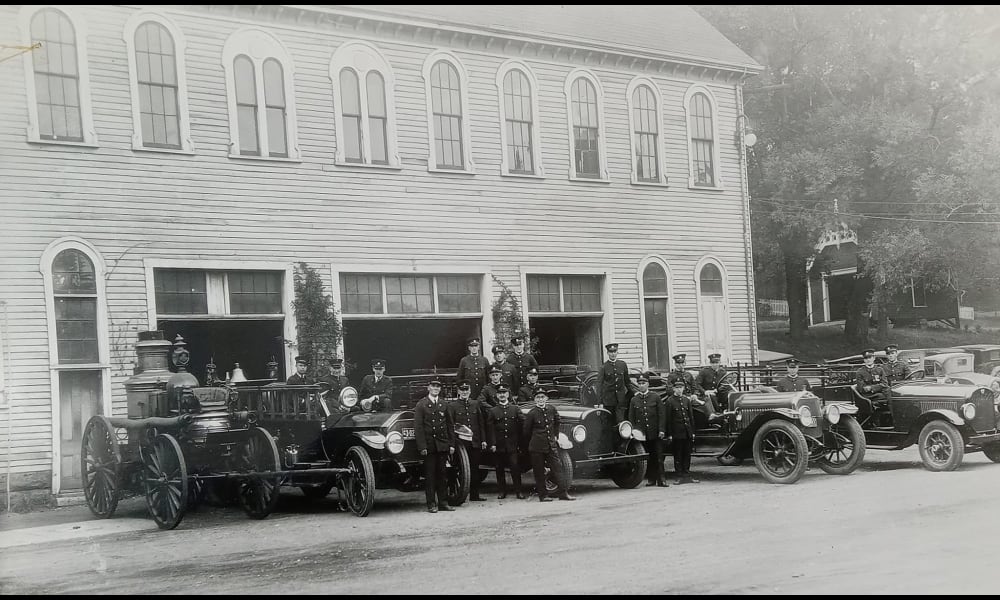
From this Special Meeting can be sensed that the era of horse drawn fire Steamers and fire Chemical wagons was coming to an end in the hearts and minds of the men in the New Glasgow Fire Brigade. It was now time to update and modernize to motorized fire apparatus.
Another event that helped pave the way for modernization was the failing health of a Fire orse. The Town engineer reported in a letter to Town Council on April 10, 1917, that the Fire Horse was becoming of little service for fire purpose; though still for general purpose. It should however, be replaced soon. The Fire horse is to heavy to use singly on street work and could not always be use in a team, so it seem best to dispose of him. The question presented was whether to replace the horse or modernize the fire Department at this point.
A meeting of the fire Committee was held on June 18, 1917. Those present were mayor Grant, Councillors Macdonald, Robertson, and P.M. Fraser, with whom were present Messrs. Frank Sutherland and F.W. Hoyt representing the Board of trade, also Chief Stewart and assistant Chief Ross; Capt. No. 2, J.Ed. MacDonald; Secretary A.M.
Douglas; J.W. McDougal and Rube McGregor representing the Firemen.
The following resolution had been unanimously passed..
RESOLVED: that we approve of the purchase of a No. 12 triple Combination
Chemical, Hose and Pump 350 gallon capacity from the American LaFrance Fire Co. of
Canada Ltd.
ALSO a chassis to accommodate the present Chemical Ladder and Hose,
American LaFrance preferred
Sgd. D.W. MacDonald
A.S. Robertson
P.M. Fraser
in New Glasgow, June 19th., 1917.
On July the 16, 1917, the Fire horse was reported to be in bad condition and the question of disposing of the horse was left to the Town Engineer and the Chairman of the Fire Committee. However, on September 10, 1917, the Town Council decided to empower the town Engineer to purchase another horse in the central until the arrival of the modernized fire apparatus.
THE HALIFAX EXPLOSION -1917
On December 6th., 1917, at about 9:00 a.m. an explosion on the munition steamer
"Mont Blanc" destroyed much of Halifax. Urgent calls for assistance were immediately sent throughout the Maritime Provinces. American was also quick to coming to their aid.
Within an hour of receiving a call about eleven o'clock, New Glasgow was sending a special train with the Steam Fire Engine "Lulan" 3000 feet of hose, a Fire Brigade.
Sixteen nurses, and eight doctors. A large quantity of clothing, etc. amounting to no less than $25000 or $26000. The Railway Department had promptly provided the special train consisting of the locomotive, flat cars, and two passenger cars.
Some of the Surgeons who traveled with the train were: Doctors M.R. McDonald; G.H. Cox; John Bell; Evan Kennedy; and John W. McKay.
Although the train was on its way by twelve o'clock it had not been able to reach the outskirts of Richmond until about four o'clock in the afternoon. The group reported to City Hall at about five-forty to get their assignments. The Doctors were split up among the cities of Halifax and Dartmouth. The Nurses were divided with one group going to the Camp Hill Hospital while the other group went to the Cogswell Street Hospital.
Although the Fire Apparatus and hose were not required, many of the men stayed within the cities and patrolled Thursday night. Some of the Fire Brigade served as hospital orderlies during Thursday night and Friday as well. This is another fine example of the Steam Fire Engine "Lulan" providing its service to another community.
The American LaFrance Fire Engine Co. of 195 Weston Road, Toronto, Ontario, sent a letter dated February 26, 1918. Attached to the letter was a Bill of Lading covering the fire truck which was being shipped that very day. The truck was shipped in Grand Trunk Car No. 32802.
The LaFrance Fire Engine arrived in the Town of New Glasgow in the month of April. Before the town accepted it, it had to first go through a series of tests. The results of the test are contained in the following report.
MOTOR FIRE ENGINE TESTS
W.W. Osborne, Esq.
Chairman of Fire Committee
April 12,1918
Town of New Glasgow
Dear Sir:
The following tests have been made with the America LaFrance Triple
combination motor fire apparatus lately received:
The appratus is a triple combination of chemical, hose wagon, and pump. The motor is a 6 cylinder 5 ½' bore 6: stroke, 72 HP. A.L.A.M. rating, 105 HP. brake test, Makers No. 1860. The pump is nominally 350 gallons per minute capacity.
Wednesday, April 10th, Pumping test of two hours duration; motor located on Public Wharf pumping form river through 10 feet to 13 feet of suction. Discharging through 150 feet of 2 1/1 inch hose with 11/8 inch nozzle; The full rated capacity discharged with 135# pump pressure and 90# nozzle pressure; Some trouble with ice in suction: After clearing for every one hour of the run pressure at pump maintained at 140# and nozzle at 97# to 98# indicating 370 gallons per minute. Remarkably, even running of motor and pump without any indication of heating of engine unduly. Test concluded with ten minute run of pump pressure of 150# and nozzle pressure of 100 - 101# giving 375 gallons per minute.
The motor was then moved to the hydrant at end of Carleton Street and line of 750 feet of hose laid to and along Norma Street, approximately 40 feet higher. Within one-half minute after starting pump pressure of 300# at the pump and 95# at the nozzle was reached, indicating a delivery of 360 gallons per minute. This test maintained for 15 minutes only; but no indication of undue heating of engine.
Friday, April 12th: Pumping test of one hour's duration: Motor located on Terrace Street at foot of Duke Street, pumping form hydrant: With single stream delivered through 150 feet of hose and 11/8 inch nozzle, the nozzle pressure indicated 350 to 360 gallons per minute: with the line siamese making delivery through a single 50 foot line to two lines of 100 feet with 1 1/8 nozzles with combined delivery was 405 to 410 gallons per minute: During this test there was no indication of undue heating of engine. A single hose line directed from hydrant delivered 230 gallons per minute through a 1 1/2" nozzle.
The above tests indicate that the pump is of the capacity specified and so far as tried out its motion is satisfactory.
Respectfully, E.S. Fraser - Town Engineer
The Town of New Glasgow pleased with the results of the tests accepted the ownership of the La France Fire Engine on April 12, 1918. ON the 15th. Of the same month the Town paid to the LaFrance Fire Engine company fo Canada a sum of $9,200.00.
The White Motor Chassis, New Glasgow's second motorized Fire Apparatus, arrived at the Station Yar in New Glasgow on the 27th. Of May, 1918. The Town had earlier decided against the purchasing of a second LaFrance just for a chassis. The original price was to have been $ 2622.50 agreed to on October 20, 1917. The sum finally paid to the Dominion General Equipment Company, Cragg Building, Halifax ( supplier of the chassis) came to the amount of $2645.50. This payment was paid on June 10, 1918.
THE LULAN LAST RUN
The Lulan's last run happened to have been an outside call to James River. The Canadian Railways, Eastern Line, loaded up firemen and the fire engine "Lulan", and took them directly to the scene of the fire, which broke out on the 23rd. Of July, 1918.
The Superintendent, District No. 4 of the C.G.R., Mr. R.H. Martin, received form the Town of new Glasgow a bill (dated July 29/18) for services of the firemen and apparatus. Mr. Martin argued that the General Superintendent, Mr. Brown, mentions that if the Town of New Glasgow were in need for assistance and called upon the railway for help in a case of this kind, he would be only too willing to render the assistance needed without remuneration. Mr. Martin stated he would make out a voucher if the Town still wanted to submit the bill. Mr. Martin further pointed out that when the Town of Port Hawkesbury was on fire they had send the S.S. Scotia from Mulgrave with fire equipment and a full crew. The Scotia was engaged at the work seven or eight hours, for which no charge was made.
The Antigonish Fire Department was also at the James River Fire on the 23rd July, for which no account had been rendered.
The Town Council took all of these points into consideration, had gone to their Fire Insurance Company to make inquiries with regards to their insurance and had later dismissed their bill to the Eastern Railway.
At the August 5th, 1918, Meeting of Town Council it was decided that all of the horses at the Central Fire Station were to be disposed of. The New Glasgow Fire Department was now completely motorized. The Chemical Fire Engine would be refitted to be attached to the White Motor Chassis. The Lulan was to be kept, (horseless), but in good working order in case its services should be again required.
The Era of Horse Drawn Fire Apparatus in New Glasgow was over.